IEEE Transactions on Robotics (T-RO) '26
Longji Yin, Yunfan Ren, Fangcheng Zhu, Liuyu Shi, Fanze Kong, Benxu Tang, Wenyi Liu, Ximin Lyu,
and Fu Zhang


Longji Yin, Yunfan Ren, Fangcheng Zhu, Liuyu Shi, Fanze Kong, Benxu Tang, Wenyi Liu, Ximin Lyu,
and Fu Zhang


- The code will be released soon.
- Jul. 21, 2026 - 🎉 Our paper has been accepted by IEEE T-RO!
- Oct. 5, 2023 - 🎉 Our conference paper on swarm tracking was selected as an IROS 2023 Best Overall and Best Student Paper Award finalist.
The preprint of the T-RO paper is available at arXiv.

Every UAV runs an identical, fully decentralized stack. Swarm-LIO2 provides onboard odometry and the swarm extrinsics from IMU and LiDAR inputs, while teammate maps, target measurements, and trajectories are exchanged over a UDP network. After spatiotemporal alignment, target state estimation and shared local mapping feed the planning module, where target prediction, SSDF update, kinodynamic searching, and spatiotemporal SE(3) trajectory optimization produce a collision-free, visibility-optimized trajectory that is tracked by an on-manifold MPC.
- Fully decentralized autonomy - the swarm flies fully autonomously, with every module computed onboard in real time.
- Heterogeneous LiDAR configurations - validated on a swarm mixing a Livox Avia, an upward-facing Mid-360, and a downward-facing Mid-360.
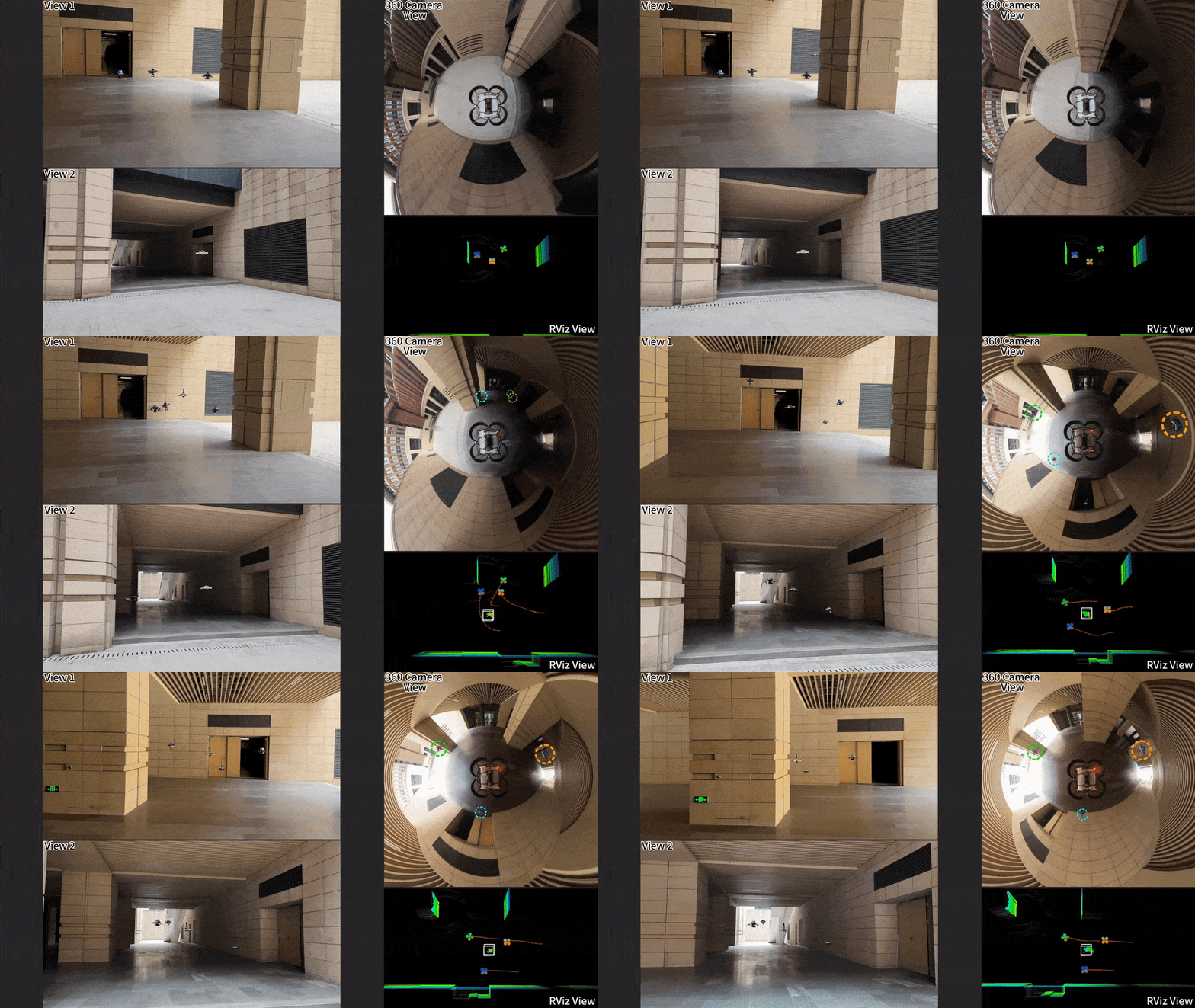
- Passive targets, unknown environments - there is no communication whatsoever between the target and the swarm, and the environments are completely unknown beforehand.
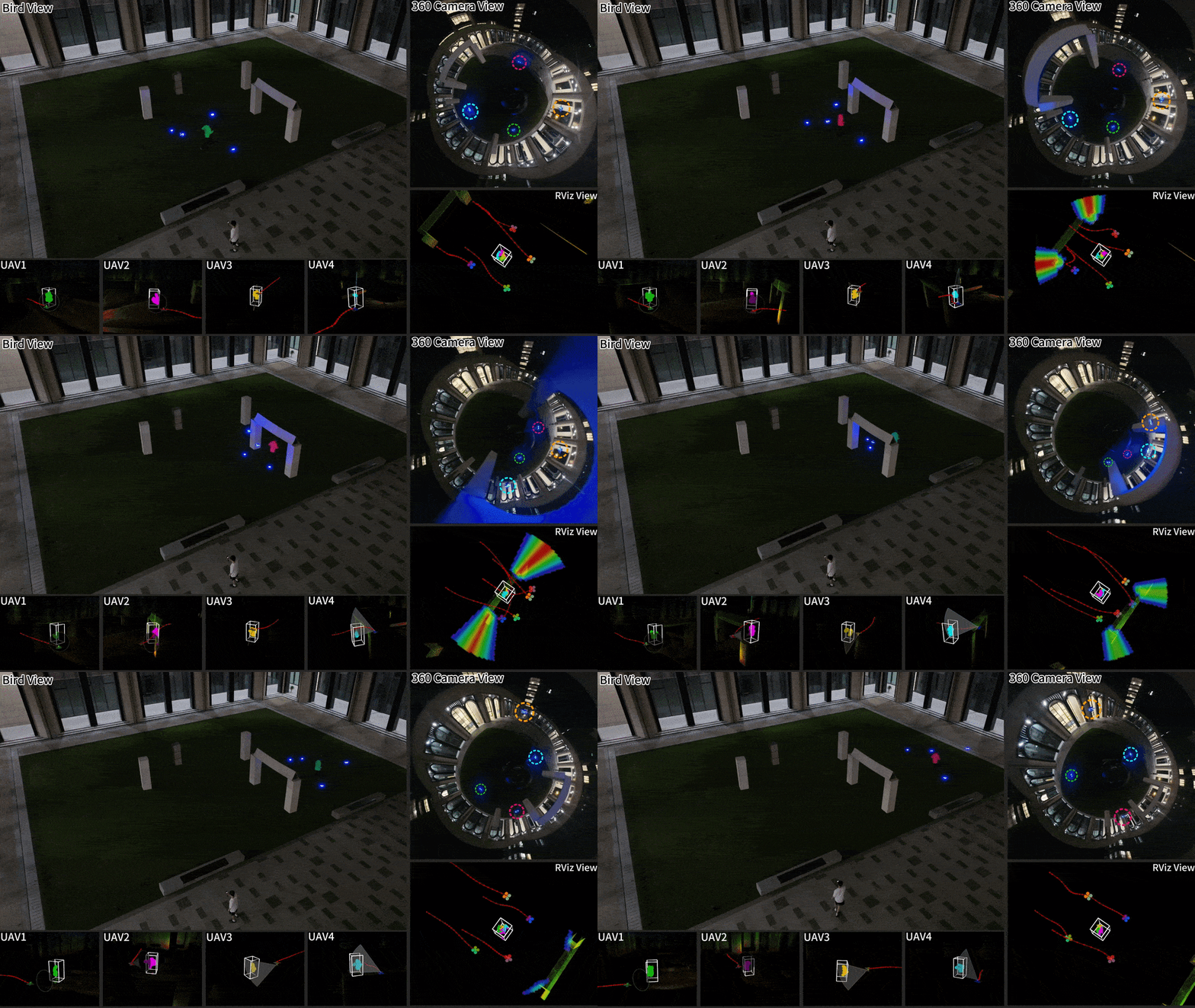
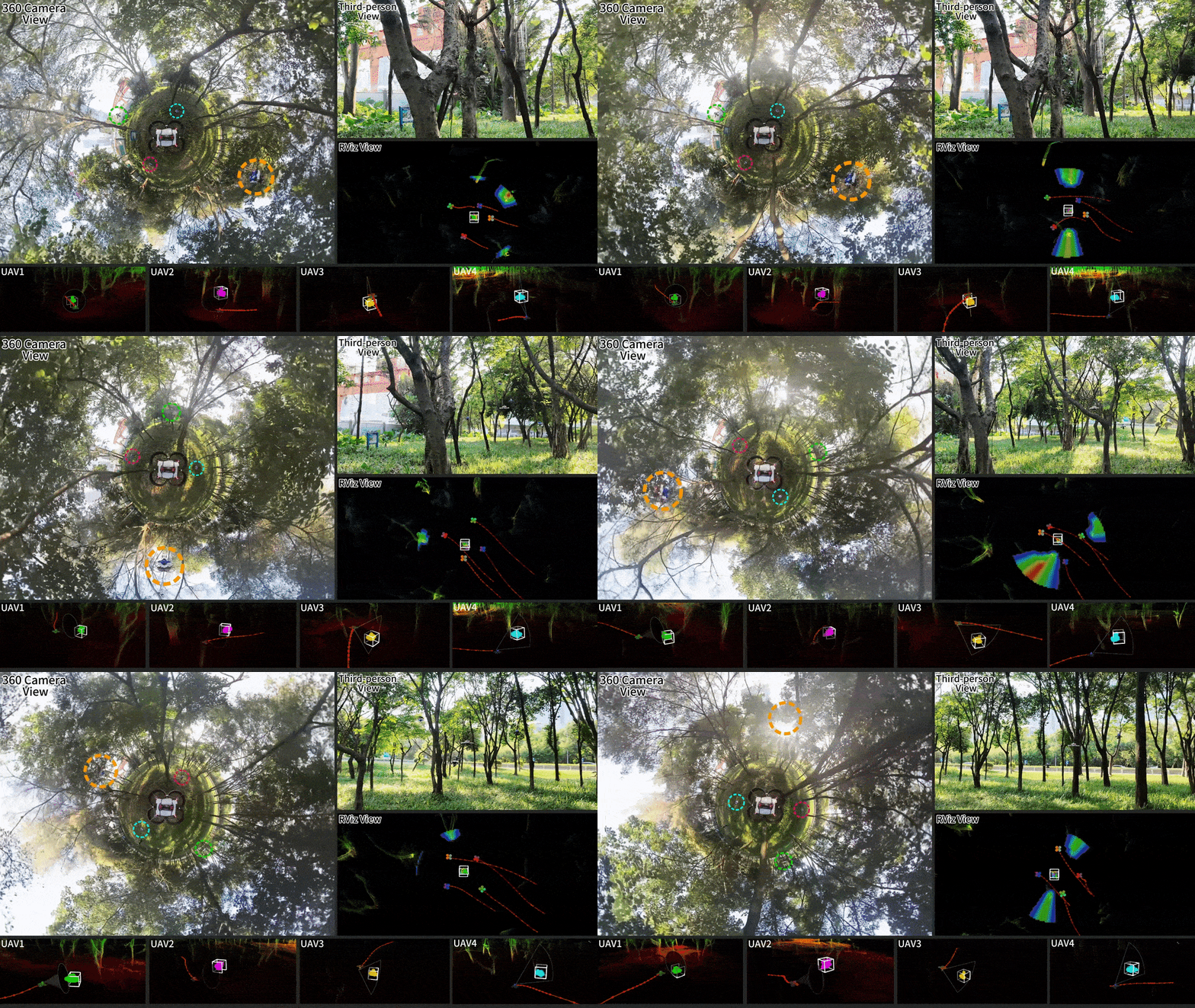
- Visibility maintenance - the swarm tracks dynamic targets while keeping them fully visible in complex outdoor environments.
(Click any clip to view the full demo video)